Miscellaneous epiwraps functions
Pierre-Luc Germain
Lab of Statistical Bioinformatics, University of Zürich;D-HEST Institute for Neuroscience, ETH Zürich, SwitzerlandSource:
vignettes/misc.Rmd
misc.RmdAbstract
This vignette introduces some more isolated epiwraps functions.
Getting read counts in regions of interest
The peakCountsFromBAM and
peakCountsFromFrags functions enable the construction of
SummarizedExperiment objects containing overlap counts of regions across
samples. peakCountsFromFrags is especially geared towards
single-cell data, splitting the frag file by cell barcodes, generating
sparse representations and optionally doing pseudo-bulk aggregation on
the fly.
The functions can also compute fragment length information for each
region, which can for instance be used with the
betterChromVAR package. For example:
suppressPackageStartupMessages(library(epiwraps))
bam <- system.file("extdata", "ex1.bam", package="Rsamtools")
# create regions of interest
peaks <- GRanges(c("seq1","seq1","seq2"), IRanges(c(400,900,500), width=100))
peakCountsFromBAM(bam, peaks, paired=FALSE, getMedianFragLength=TRUE)
## class: RangedSummarizedExperiment
## dim: 3 1
## metadata(0):
## assays(1): counts
## rownames(3): seq1:400-499 seq1:900-999 seq2:500-599
## rowData names(1): flbias
## colnames(1): ex1
## colData names(2): total_depth depthQuality control
Coverage statistics
Coverage statistics give an overview of how the reads are distributed
across the genome (or more precisely, across a large number of random
regions). The getCovStats will compute such statistics from
bam or bigwig files (from bigwig files will be considerably faster, but
if the files are normalized the coverage/density will be relative).
Because our example data spans only part of a chromosome, we’ll
exclude completely empty regions using the exclude
parameter, which would normally be used to exclude regions likely to be
technical artefacts (e.g. blacklisted regions).
# get the path to an example bigwig file:
bwf <- system.file("extdata/example_atac.bw", package="epiwraps")
cs <- getCovStats(bwf, exclude=GRanges("1", IRanges(1, 4300000)))
plotCovStats(cs)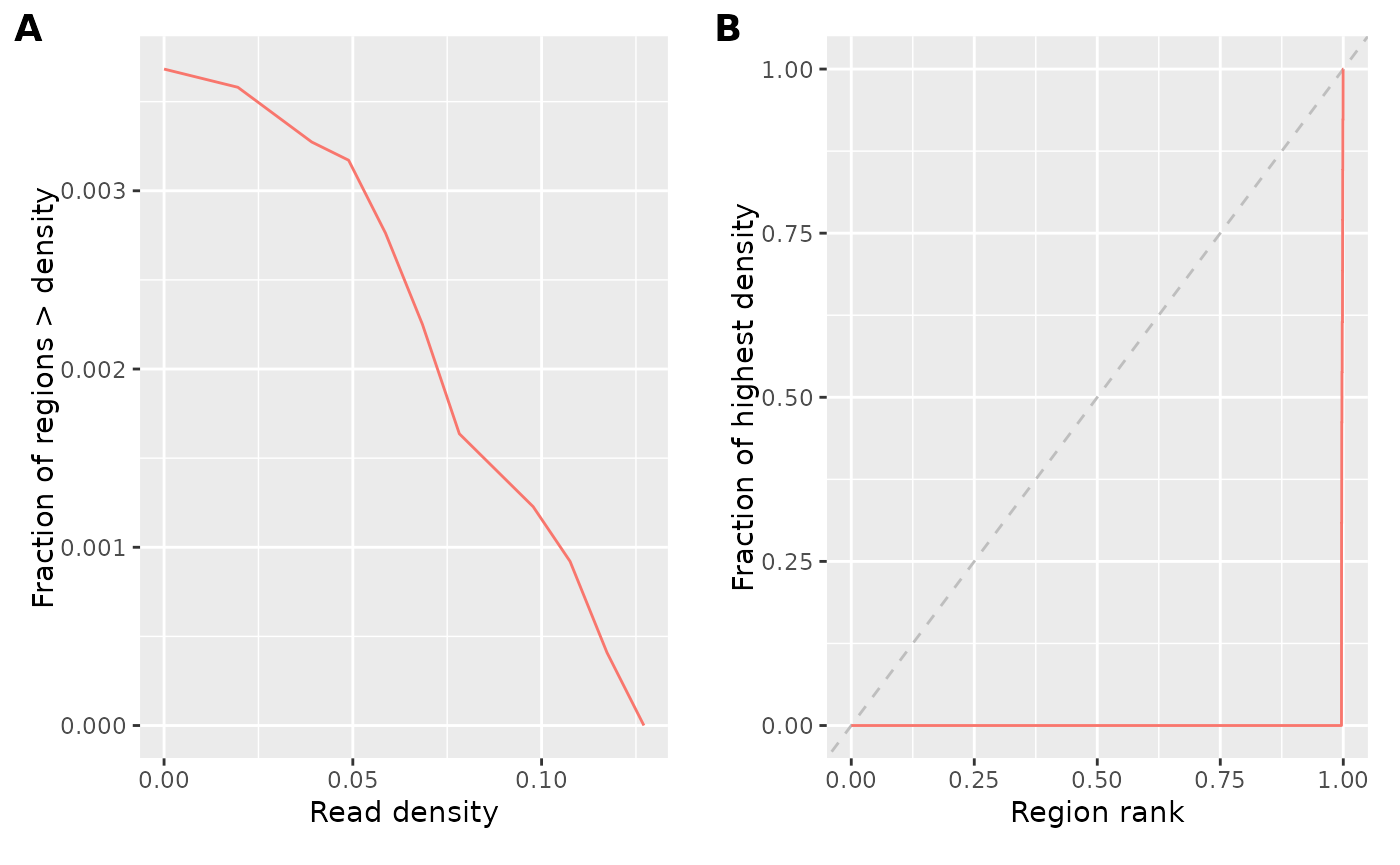
Panel A shows the proportion of sampled regions which are above a certain read density (relative because this is a normalized bigwig file, would be coverage otherwise). This shows us, for example, that as expected only a minority of regions have any reads at all (indicating that the reads are not randomly distributed). Panel B is what is sometimes called a fingerprint plot. It similarly shows us that the reads are concentrated in very few regions, since the vast majority of regions have only a very low fraction of the coverage of a few high-density regions. Randomly distributed reads would go along the diagonal, but one normally has a curve somewhere between this line and the lower-right corner – the farther away from the diagonal, to more strongly enriched the data is.
This can be done for multiple files simultaneously. If we have
several files, we can also use the coverage in the random windows to
computer their similarity (see ?plotCorFromCovStats).
Fragment length distributions
Given one or more paired-end bam files, we can extract and plot the fragment length distribution using:
fragSizesDist(bam, what=100)Peak calling
A peak calling function can be used, either against an input control or against local or global backgrounds:
p <- callPeaks(bam)Note that the peak caller was developed chiefly to facilitate teaching, and we do not guarantee its performance.
Region merging
The merging of genomic regions with reduce tends to
produce large regions which are undesirable for some downstream
analyses. As an alternative, the reduceWithResplit function
splits large merges using local overlap minima.
Region overlapping
The GenomicRanges package offers fast and powerful
functions for overlapping genomic regions. epiwraps
includes wrappers around those for common tasks, such as calculating and
visualizing overlaps across multiple sets of regions (see
?regionsToUpset, ?regionOverlaps, and
?regionCAT).
Session information
## R version 4.6.1 (2026-06-24)
## Platform: x86_64-pc-linux-gnu
## Running under: Ubuntu 24.04.4 LTS
##
## Matrix products: default
## BLAS:   /usr/lib/x86_64-linux-gnu/openblas-pthread/libblas.so.3
## LAPACK: /usr/lib/x86_64-linux-gnu/openblas-pthread/libopenblasp-r0.3.26.so;  LAPACK version 3.12.0
##
## locale:
##  [1] LC_CTYPE=C.UTF-8       LC_NUMERIC=C           LC_TIME=C.UTF-8
##  [4] LC_COLLATE=C.UTF-8     LC_MONETARY=C.UTF-8    LC_MESSAGES=C.UTF-8
##  [7] LC_PAPER=C.UTF-8       LC_NAME=C              LC_ADDRESS=C
## [10] LC_TELEPHONE=C         LC_MEASUREMENT=C.UTF-8 LC_IDENTIFICATION=C
##
## time zone: UTC
## tzcode source: system (glibc)
##
## attached base packages:
## [1] grid      stats4    stats     graphics  grDevices utils     datasets
## [8] methods   base
##
## other attached packages:
##  [1] epiwraps_0.99.125           EnrichedHeatmap_1.42.0
##  [3] ComplexHeatmap_2.28.0       SummarizedExperiment_1.42.0
##  [5] Biobase_2.72.0              GenomicRanges_1.64.0
##  [7] Seqinfo_1.2.0               IRanges_2.46.0
##  [9] S4Vectors_0.50.1            BiocGenerics_0.58.1
## [11] generics_0.1.4              MatrixGenerics_1.24.0
## [13] matrixStats_1.5.0           BiocStyle_2.40.0
##
## loaded via a namespace (and not attached):
##   [1] DBI_1.3.0                bitops_1.0-9             pbapply_1.7-4
##   [4] rlang_1.3.0              magrittr_2.0.5           clue_0.3-68
##   [7] GetoptLong_1.1.1         otel_0.2.0               compiler_4.6.1
##  [10] RSQLite_3.53.3           GenomicFeatures_1.64.0   png_0.1-9
##  [13] systemfonts_1.3.2        vctrs_0.7.3              ProtGenerics_1.44.0
##  [16] pkgconfig_2.0.3          shape_1.4.6.1            crayon_1.5.3
##  [19] fastmap_1.2.0            XVector_0.52.0           labeling_0.4.3
##  [22] Rsamtools_2.28.0         rmarkdown_2.31           UCSC.utils_1.8.0
##  [25] ragg_1.5.2               bit_4.6.0                xfun_0.60
##  [28] cachem_1.1.0             cigarillo_1.2.0          GenomeInfoDb_1.48.0
##  [31] jsonlite_2.0.0           blob_1.3.0               DelayedArray_0.38.2
##  [34] BiocParallel_1.46.0      parallel_4.6.1           cluster_2.1.8.2
##  [37] VariantAnnotation_1.58.0 R6_2.6.1                 bslib_0.11.0
##  [40] RColorBrewer_1.1-3       rtracklayer_1.72.0       jquerylib_0.1.4
##  [43] Rcpp_1.1.2               bookdown_0.47            iterators_1.0.14
##  [46] knitr_1.51               Matrix_1.7-5             tidyselect_1.2.1
##  [49] dichromat_2.0-0.1        abind_1.4-8              yaml_2.3.12
##  [52] doParallel_1.0.17        codetools_0.2-20         curl_7.1.0
##  [55] lattice_0.22-9           tibble_3.3.1             withr_3.0.3
##  [58] KEGGREST_1.52.2          S7_0.2.2                 evaluate_1.0.5
##  [61] desc_1.4.3               circlize_0.4.18          Biostrings_2.80.1
##  [64] pillar_1.11.1            BiocManager_1.30.27      foreach_1.5.2
##  [67] RCurl_1.98-1.19          ensembldb_2.36.1         ggplot2_4.0.3
##  [70] scales_1.4.0             GenomicFiles_1.48.0      glue_1.8.1
##  [73] lazyeval_0.2.3           tools_4.6.1              BiocIO_1.22.0
##  [76] data.table_1.18.4        BSgenome_1.80.0          locfit_1.5-9.12
##  [79] GenomicAlignments_1.48.0 XML_3.99-0.23            fs_2.1.0
##  [82] AnnotationDbi_1.74.0     colorspace_2.1-2         patchwork_1.3.2
##  [85] restfulr_0.0.17          cli_3.6.6                textshaping_1.0.5
##  [88] viridisLite_0.4.3        S4Arrays_1.12.0          dplyr_1.2.1
##  [91] AnnotationFilter_1.36.0  gtable_0.3.6             sass_0.4.10
##  [94] digest_0.6.39            SparseArray_1.12.2       rjson_0.2.23
##  [97] htmlwidgets_1.6.4        farver_2.1.2             memoise_2.0.1
## [100] htmltools_0.5.9          pkgdown_2.2.1            lifecycle_1.0.5
## [103] httr_1.4.8               GlobalOptions_0.1.4      bit64_4.8.2